Fast Casual Executive Summit
How Velvet Taco CEO Chris Schultz scales a cult brand without losing its soul
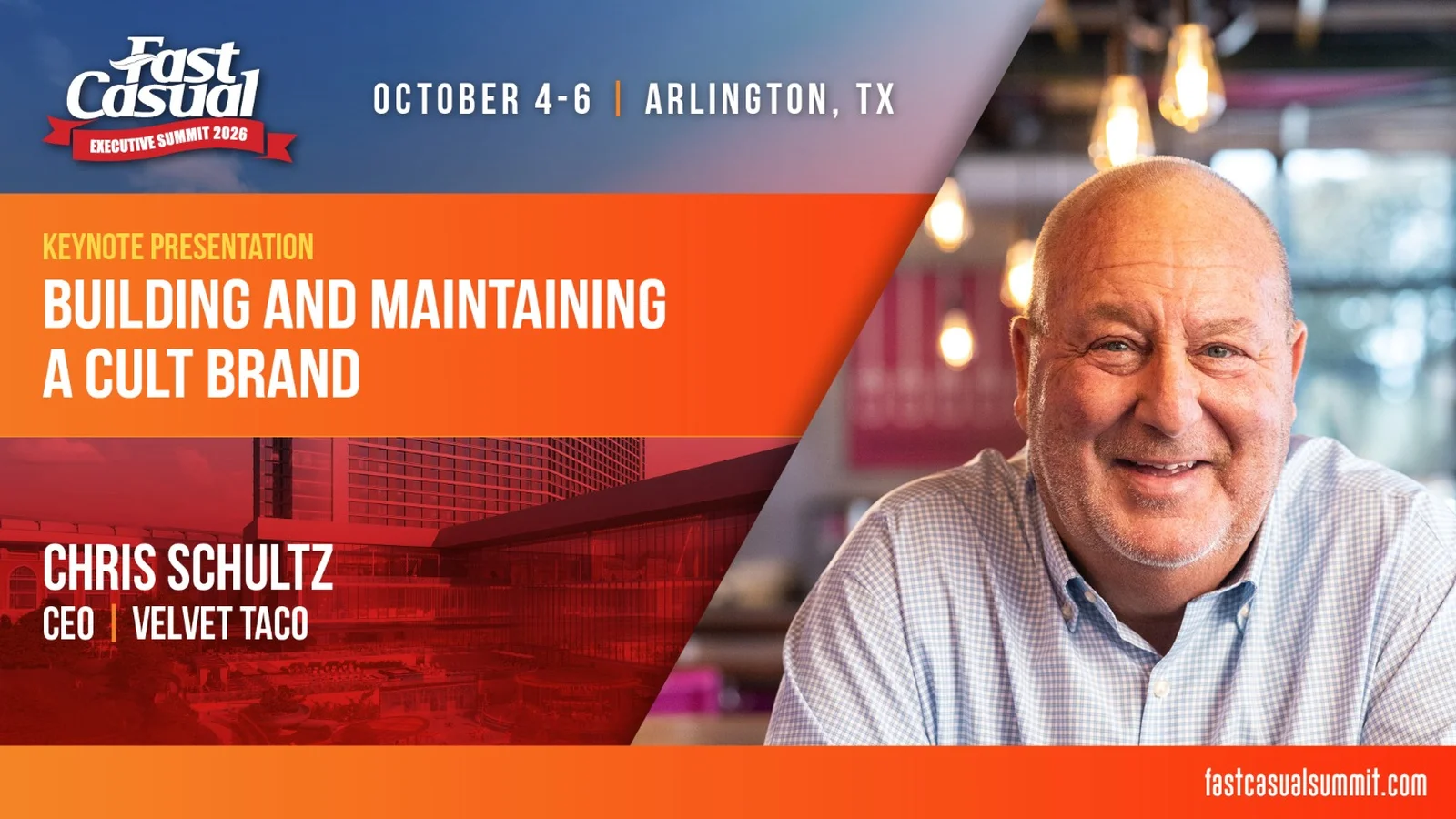
During his keynote at the Fast Casual Executive Summit in Texas, Chris Schultz will discuss restaurant growth, brand culture, leadership, international expansion and why protecting a fast-casual brand's identity matters more than opening the next location.
June 30, 2026 by Mandy Wolf Detwiler — Editor, Connect Media
 ChatGPT
 Grok
Grok Perplexity
 Claude
Chris Schultz knows the exact moment a fast-casual restaurant chain transforms from a popular lunch spot into a full-blown cult obsession: it's the precise second a guest stops viewing their meal as a mere transaction and starts feeling like the brand belongs to them. As the CEO of Velvet Taco — the Dallas-founded phenomenon scaling past 50 units and pushing boundaries from sterile airport terminals to the streets of London in 2026 — Schultz is tasked with a high-stakes balancing act. It is a corporate mission defined by aggressive expansion but governed by a deeply human philosophy. To guide a brand with this much attitude through its next massive growth phase, Schultz isn't just staring at private equity spreadsheets; he is actively fighting "brand drift" on the ground, creating a "wide boulevard with high curbs" for culinary creativity and ensuring that the people infrastructure always moves faster than the development schedule to protect the fiercely guarded magic inside the box.
Schultz will headline the Fast Casual Executive Summit as the keynote speaker for "Building and Maintaining a Cult Brand" October 4 in Arlington, Texas. The show brings together fast casual and restaurant executives for two-and-a-half days of education, networking and thought leadership. To register for the show, click here.
We talked to Schultz in an email Q&A ahead of his keynote address to learn more about his time as an executive in the industry and how he is leading Velvet Taco to culinary and growth success.
Q: You've worked with Starbucks, MOD Pizza, Voodoo Doughnut and now Velvet Taco. All four have incredibly distinct identities. In your eyes, what is the exact tipping point where a "popular fast-casual chain" crosses the line to become a "cult brand"?
Schultz:To me, a brand crosses that line when guests stop thinking about it as just a place to eat and start feeling like the brand is somehow theirs.
A popular brand can have great food, strong sales, and a lot of awareness. A cult brand creates a different kind of connection. Guests talk about it, defend it, bring other people to it, and in some cases forgive the occasional imperfection because they believe in what the brand is.
That is the tipping point. It is no longer just a transaction. It becomes something people want to be associated with and talk about.
Q: In your keynote description, you mention the "trap of brand drift." When a brand is expanding rapidly, what does the very first warning sign of brand drift look like on the ground before it shows up in the financial data?
Schultz:You usually feel it before you can measure it.
I can walk into a restaurant that technically looks right, but something feels off. The energy is different. The team may be doing the steps, but they do not really understand the personality of the brand. The food may be correct, but it starts to feel a little more generic. The guest may not be able to explain it, but they can feel it too.
That is usually where drift starts. Not with one major miss, but with a lot of little things that make the brand less distinct.
By the time it shows up in the financial data, it has probably been happening for a while. My job is to catch it when it is still showing up in the guest and team experience, not after it has become a sales problem.
Q: Velvet Taco is famous for its Weekly Taco Feature, which has been running for nearly 15 years, and recently introduced Velvet Bowls. How do you maintain rigorous operational excellence and supply chain stability while simultaneously letting your culinary teams stay completely uninhibited and creative?
Schultz:I think about it as creating a wide boulevard for creativity, but with high curbs from an operational execution standpoint.
The culinary team should have plenty of room to bring forward ideas that are unexpected, fun, and very Velvet Taco. That is part of what makes the brand special. But the idea still has to stay on the road. Can we source it? Can we train it? Can the restaurants execute it consistently during a rush? Does it still feel like Velvet Taco when it gets to the guest?
If the answer is yes, then the operational discipline is not limiting creativity. It is helping the creativity actually work.
That is why WTF has been such a powerful program for the brand. It gives us permission to stay creative and give guests something new to talk about, but it only works because there is discipline behind it. Velvet Bowls are the same idea. They give guests another way to use the brand, but they still have to feel like us and work inside the restaurant.
Q: You recently inherited a brand that was successfully shepherded by Clay Dover for over eight years, and you've spoken about the importance of "learning to get out of the way and letting a "brand be a brand." How do you balance honoring a founder/previous CEO's deeply entrenched blueprint while still asserting your own vision for its next massive growth phase?
Schultz:When you come into a brand with this much personality, you have to be careful not to confuse changing the company with improving the company.
Velvet Taco already has a very clear point of view. The food is bold. The brand has attitude. The guest understands it. The team understands it. So the first job is to understand what makes the brand work and what should not change.
At the same time, respecting the brand does not mean assuming every part of the business is already built for the next stage of growth. Growth exposes gaps. It shows where the systems need to be stronger, where the leadership structure needs to evolve, and where the operating model has to mature.
Protect the parts of Velvet Taco that make it special, but be honest about where the company needs to evolve. My job is not to reinvent the brand. My job is to make sure the company around the brand is strong enough to support where we want to take it.
Q: Velvet Taco is expanding into non-traditional footprints like airports and entertainment districts, alongside international growth into markets like London. When you take a brand known for an "edgy, late-night vibe" and put it into a sterile airport terminal or a brand-new country, how do you preserve the "magic in the box"?
Schultz:The hard part is that the restaurant cannot just look like the brand. It has to feel like the brand. The box may change, but the attitude cannot.
An airport is not a late-night restaurant in Dallas, and London is not a U.S. market. The guest occasion is different, and the footprint, menu flow, hours, and operating model may all be different. You have to be honest about that. But if you flex everything, you lose the brand.
So, the work is being very clear on what can change and what cannot. We can adapt the format, but the food still has to be bold, the brand still has to have an edge, and the team still has to bring the energy. The guest has to feel like they found Velvet Taco, not a safer version of it.
That is how the magic travels. Not by copying the same box everywhere, but by knowing which parts of the brand are non-negotiable.
Q: You've noted that standard private equity often gets restaurant culture completely wrong when it comes to scaling. What is the biggest disconnect between traditional PE growth metrics and the actual human infrastructure required to keep a cult brand alive?
Schultz:I would not frame it as private equity getting it wrong as much as I would say restaurant growth can get ahead of the people infrastructure if you are not careful.
The spreadsheet will usually move faster than the organization can. You can model the units, the openings, and the EBITDA. Those things matter. But none of that carries the brand. People do.
You can build restaurants faster than you can build leaders. That is where brands get into trouble.
A development schedule can look great on paper, but if the leadership pipeline, training, culture, and restaurant-level execution are not keeping up, the guest eventually feels it. The building may be open, the sign may be up, and the sales may even look good early. But if the people side is not ready, the brand starts to lose what made it special.
For me, responsible growth is not just about how many restaurants we can open. It is whether the company underneath the brand is strong enough to support the growth without diluting what made the brand valuable in the first place.
Q: The fast-casual industry is facing a massive shift from a "hiring" crisis to a "holding" crisis, where employee retention is everything. How do you cultivate a workplace culture at Velvet Taco where frontline employees feel like stakeholders rather than just line cooks executing SOPs?
Schultz:Culture has become one of those words almost every company uses to describe its strengths. The real test is not whether we talk about it. It is whether our teams feel it every day in the restaurants.
I would also be careful with the word stakeholder. People do not feel like stakeholders because we call them that. They feel it when they understand the business, have a real voice in how the restaurant works, and feel part of something bigger than the shift they are working.
That requires leadership close enough to the restaurants to know what is actually happening. The teams closest to the guest know when a process is helping them and when it is getting in their way. They know when a menu item works and when it does not.
None of that means every decision is made by committee. Standards and accountability still matter. But if the people closest to the guest do not feel heard, you will not get the ownership you need.
People stay when they feel supported, challenged, and connected to something they believe in. Retention is not solved by a poster or a speech about culture. It is solved in the daily operating rhythm: how managers coach, how leaders show up, how well we train, how clearly we communicate, and whether people can see a future for themselves here.
Q: You have a great quote: "If I'm the smartest man in the room, I need a new room." As you guide Velvet Taco through 2026 and beyond, what is a specific limitation you've had to recognize in yourself, and who did you hire to fill that gap?
Schultz:The discipline for me is making sure my experience does not turn into assumption.
Experience matters. I have been fortunate to work with some great brands, and each of them taught me something different. But Velvet Taco is its own thing. The answer from Starbucks, MOD, or Voodoo does not automatically apply here.
So my job is not to prove what I know. My job is to listen, understand what makes this brand work, and build the room that makes the answer better.
I also do not think about leadership as one hire filling one gap. That is too simplistic. At this stage of growth, it is about making sure the leadership team has the right mix around the table. That may mean adding leaders. It may mean taking a hard look at the leaders already in the business and making sure they are in the right roles for where the company is going.
The goal is to have the brand, the operation, the numbers, and the people side all challenging and making each other better. I do not need to be the smartest person in the room. I need the room to be strong enough to challenge the thinking and help us make better decisions.
To learn more about the Fast Casual Executive Summit, click here.
Upcoming Events
Fast Casual Executive Summit
October 4-6, 2026 | Arlington, TX
The fast casual industry's BIGGEST event is back! Join industry leaders for game-changing ideas, powerful networking and serious fun.
View AgendaRegister NowAbout Mandy Wolf Detwiler

Mandy Wolf Detwiler is the Pizzamarketplace.com and QSRweb.com editor for Connect Media. An award-winning journalist, Mandy brings more than 20 years’ experience covering food, people and places. Mandy has been featured on the Food Network and has won numerous awards for her coverage of the restaurant industry. She has an insatiable appetite for learning, and, yes, she can tell you where to find the best pizza slices in the country.
Related Media
Subscribe
Get the latest news and resources from Food Truck Operator.
Recent Posts



Recent Podcasts