Fast Casual Executive Summit
Fast Casual Executive Summit preview: Learn how a unified guest view spurs big rewards
Fast casual brands can break down the walls between tech systems to craft a unified customer view that can drive an immediate return-on-investment. Learn how at the Fast Casual Executive Summit taking place Oct. 4-6 in Arlington, Texas.
September 2, 2026 by Judy Mottl — Editor: RetailCustomerExperience.com & DigitalSignageToday.com, Connect Media
 ChatGPT
 Grok
Grok Perplexity
 Claude
There's an infamous saying about the restaurant industry, as well as any retail business: The customer is always right.
But just as important is the need to know the customer — attaining a unified view of the guest.
It's not an easy undertaking despite the growing reams of customer data restaurants are collecting within a slew of strategies, from loyalty programs to point of sale. A big challenge is that data is siloed so getting a 'total guest picture' is a tough task.
Yet it can be done if fast casual brands break down the walls between tech systems to craft that unified view that can then drive an immediate return-on-investment.
Expert insight
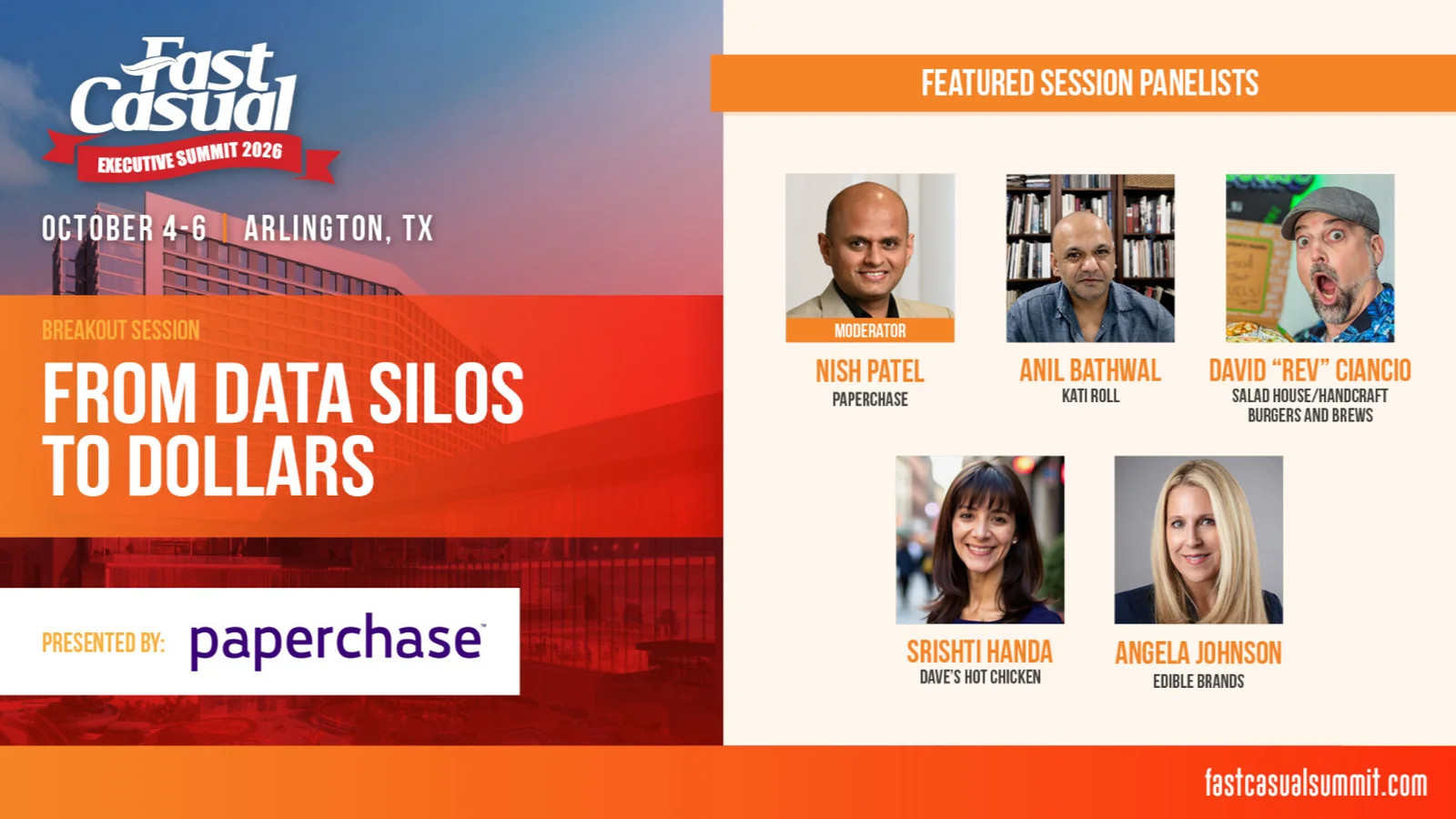
Just how to accomplish all that is the focus of a panel talk at the upcoming Fast Casual Executive Summit taking place Oct. 4-6 in Arlington, Texas.
The session, "From Data Silos to Dollars," sponsored by paperchase and moderated by Nish Patel, paperchase CEO, features expert insight from restaurant leaders who are using data to drive every decision — from menu engineering to real estate expansion. The goal is connecting the dots between the point of sale, loyalty and online ordering to know who the guests are and how to increase their spend.
Panelists include David "Rev" Ciancio, co-founder and chief marketing officer of Salad House/Handcraft Burgers and Brews; Srishti Handa, vice president of marketing, brand and growth at Dave's Hot Chicken and Jason Morgan, CEO of Original ChopShop.
[RELATED MEDIA]
Why a unified view is needed
The future of restaurant marketing is personalization, according to Ciancio, and the better a restaurant's data set is directly tied knowing the customer.
"True one-to-one marketing is still difficult and expensive for most brands today, but it's becoming more accessible every day. In the meantime, there is a huge opportunity for restaurants to get much smarter about segmentation," Ciancio said in an email interview.
He recommends brands start with knowing their best guests — the most frequent, the most engaged — and identify behaviors they have in common.
"Then look at the guests who are already showing some of those behaviors but have not become your best guests yet," said Ciancio. "What separates someone who has visited five times from someone who has visited 10 or even 20 times? That is where I think there is a tremendous opportunity."
The goal is to figure out how to get "pretty good guests:" to behave more like the best guest.
"There is a stat that gets cited all the time that claims somewhere around 70% to 80% of restaurant guests only visit once. The natural reaction is, 'if I could just get more of those first-time guests to come back, that would be huge.' That is not wrong, but you are also fighting a macro human behavior," said Ciancio.
By identifying behaviors that correlate with best customers a brand can create strategies designed to drive more of that behavior.
That's where data proves invaluable, said Ciancio.
"That is where connecting your data becomes so powerful. Instead of guessing what marketing campaign to run next, you can identify the behaviors that correlate with your best customers,"
Where and how to start
The best first step, advised Ciancio, is starting with understanding purchase behavior.
"What do our best guests do differently from everybody else? Once you understand your best guests, analyze the people who appear to be on the path toward becoming those guests," he said. " What are they doing similarly? What are they not doing yet? That gives you something actionable rather than just another dashboard."
And don't ignore the 'sentiment' aspect.
"Behavioral data tells you what somebody did. It does not necessarily tell you why they did it, why they keep doing it, or why they might stop doing it," said Ciancio.
A second best practice is to ask guests, after every visit, how the experience was.
"It gives you another incredibly valuable data set. When you can connect what a guest did with how they felt about the experience, you get a much clearer picture of what is working, what is not working, and where the opportunity is," said Ciancio.
"Ultimately, the goal of better data management is not to have more data. It is to spend less time wondering what to do next and more time figuring out how to make more of your best guests."
Fast Casual Executive Summit — Oct. 4-6, 2026 | Arlington, TX |
Upcoming Events
Fast Casual Executive Summit
October 4-6, 2026 | Arlington, TX
The fast casual industry's BIGGEST event is back! Join industry leaders for game-changing ideas, powerful networking and serious fun.
View AgendaRegister NowAbout Judy Mottl

Judy Mottl is the editor of RetailCustomerExperience.com and DigitalSignageToday.com at Connect Media. She is an award-winning editor, reporter and blogger who has worked for top media for nearly four decades, including AOL, InformationWeek and Internet News, as well as for leading technology providers including HP. She’s written everything from breaking news to in-depth industry trends and reported on technology long before the internet arrived, including the debut of the first smartphone. When she's not sharing insights on digital signage deployments and trends in retail customer experience she's on the beach or watching the latest live murder trial.
Related Media
Subscribe
Get the latest news and resources from Food Truck Operator.
Recent Posts




Recent Podcasts